
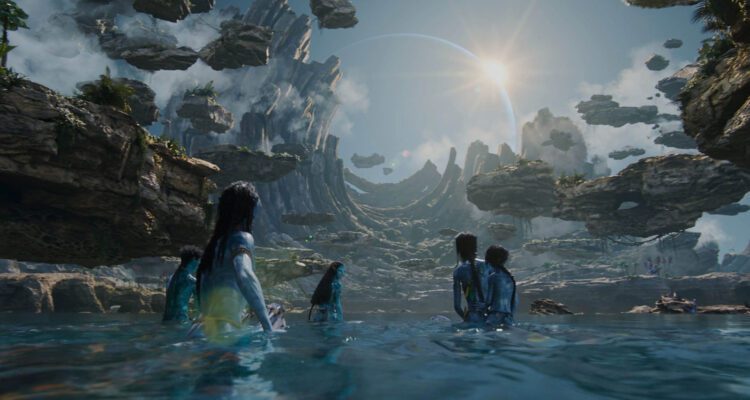
Pour une attente, ce fut une attente ! Treize ans. Treize années à travailler, retravailler, patiner, repatiner la suite des aventures de Jake Sully, Neytiri et des quelques autres abandonnés sur la planète Pandora après avoir explosé les compteurs d’un box-office désormais phagocyté par quelques super-héros sans contours. Comme si la seule chose retenue du premier Avatar avait été la masse phénoménale de dollars engendrés. L’équation était pourtant un peu plus compliquée. Alors, évidemment, le film de James Cameron, malgré son succès critique et public, s’était logiquement fait harponner sur son scénario jugé simpliste quand la simplicité se suffit à elle-même. Caricature. Mais il fallait bien taper quelque part. Trouver des arguments. Flinguer à vue. Et dans la catégorie des réalisateurs que tous les Cassandre voient exploser en plein vol à chaque film, notre homme est bien placé. En tête de liste. En adepte de projets hors norme, le réalisateur a donc profité de ce hiatus pour écrire quatre suites afin de prolonger la visite guidée d’un monde qu’il avait imaginé à 19 ans. Son génie de metteur en scène et les avancées technologiques feront le reste.
Et de technologie il est toujours question dans cette suite, au cœur même du projet sur le fond et sur la forme avec l’utilisation efficace de la 3D et une amplitude musicale immersive. Car au-delà du son, déjà impressionnant, l’omniprésence de la bande originale de Simon Franglen s’appuie essentiellement sur les thèmes du regretté James Horner et se déploie jusqu’à la saturation. Dès lors, le spectateur ne peut plus reculer ni échapper à ce qu’il voit et ce qu’il entend, pris dans une incessante machinerie narrative, étourdissante, époustouflante. Paradoxalement, l’utilisation parcimonieuse du HFR (principe de fréquence d’images) fluidifie l’action quand l’imagerie passe de 24 à 48 images par secondes mais provoque une fausse impression de rythme saccadé quand le film revient à la « normale« . Cette sensation pourra convenir. Ou pas. Dans tous les cas, l’expérience sensorielle est là, habitée jusqu’aux moindres détails, aux moindres bruits, et réglée pour en mettre plein la gueule au point qu’il faudra quelques minutes après la projection pour se réhabituer à notre foutu « monde réel« .
Le pouvoir de fascination pousse les potards à fond, pendant trois heures et quart, sans jamais donner l’occasion de s’ennuyer… hormis pour la cohorte d’allergiques au concept, au film, à la SF ou tout à la fois. Pourtant, le film dépasse le clivage du genre. En proposant une narration composée d’archétypes venus du western, et l’attaque du train en est l’une de ses plus évidentes représentations, de mythes universels et de métaphores transculturelles, le film peut dérouler son propos autour de la valeur la plus partagée car la plus rassurante : la famille (bonjour Mr Spielberg). En appuyant son propos jusque dans une voix-off blindée de mantras touchants de naïveté, Avatar La Voie de l’Eau ne joue pas la subtilité, à peine le sous-texte, et flirte même avec un fond légèrement réactionnaire qui pourra désarçonner : Sully élève ses enfants aux pas cadencés, que ces derniers donnent du « Monsieur » dans une organisation somme toute militaire, que tout se plie et se déplie autour des membres d’une famille hétérogène composée de Na’vis d’origine (Naytiri), « transformé » (Jake) ou « mélangés », (Neteyam, Lo’ak, Tuk) et d’une immaculée conception un tantinet messianique (Kiri) mais finalement réunis dans un « seuls contre tous » sur fond d’héritage et de loi du talion qui évite in-extremis le jusqu’au-boutisme primal.
Cet enchevêtrement enrobe un film régit par l’accumulation où la finitude spirituelle trouve son éternité dans la forme de l’eau. Cette communion avec la nature qui serait la source d’une immortalité fantasmée dans notre monde mais bien réelle sur Pandora relève de la rêverie transhumaniste. La mythologie est en marche et le simple nom Pandora en est la clé de voûte puisqu’elle nous renvoie à la première femme humaine façonnée par les dieux (fécondité, création, l’eau, la terre, tout ça). Cette relation aux imageries quasi religieuses comme cette cohorte d’humains montrés comme des anges déchus, accentue l’appropriation universelle de l’histoire, de même que l’anthropomorphisme des personnages et les dialogues finalement très contemporains qui s’épargnent un sous-titrage quasi-permanent ; le spectateur doit pouvoir se projeter dans l’histoire racontée !
Avec cette suite, Cameron passe la surmultipliée jusqu’à la sidération, à l’image de ce qu’avait produit Terminator 2 par rapport à son prédécesseur, ouvrant plus que la voie de l’eau, celle de la franchise. Parc d’attraction en prime. Car en créant son propre univers, voire son univers propre, focalisé sur le beau et la phosphorescence pour accentuer l’émerveillement, le réalisateur parvient à construire une aventure dont on pourra toujours dire qu’il n’invente pas tant que ça, mais qui mélange les influences et les sources avec assez d’habileté pour redéfinir le grand spectacle, le film grand large intergénérationnel dans un paradigme audiovisuel phagocyté par les plateformes et les réseaux sociaux. Sans faillir, Avatar se mue en point d’ancrage de la jeune génération et de façon plus prosaïque en nouvelle borne dans l’histoire du cinéma comme le fut en son temps un certain Star Wars. James Cameron peut alors laisser naviguer sa mise en scène au fil de ses visions avec une maitrise impressionnante tant sur les séquences d’action, qui vont convoquer tout un pan de sa filmographie (la fonderie de Terminator, le naufrage de Titanic, la poursuite dans les fonds marins de Abyss, les mécas de Aliens…) moins par prétention que pure efficacité. En multipliant les climax dans la séquence finale et en inversant les rapports entre enfants et parents, le film ouvre le champ des possibles tant le spectaculaire proposé surpasse, et de loin, une concurrence moribonde dont on pourra une nouvelle fois se demander ce qu’elle pourra offrir pour essayer de suivre ses traces. En attendant la suite.
ENGLISH VERSION
For a wait, it was a wait! Thirteen years. Thirteen years of working, reworking, skating, repatinating the sequel to the adventures of Jake Sully, Neytiri and the few others abandoned on the planet Pandora after having exploded the box-office counters now phagocyted by a few superheroes without contours. As if the only thing retained from the first Avatar had been the phenomenal mass of dollars generated. The equation was a little more complicated, however. So, obviously, James Cameron’s film, despite its critical and public success, was logically harpooned on its scenario judged simplistic when simplicity is enough in itself. Caricature. But it was necessary to hit somewhere. To find arguments. To kill on sight. And in the category of directors that all the Cassandras see exploding in full flight with each film, our man is well placed. At the top of the list. As a fan of extraordinary projects, the director has taken advantage of this hiatus to write four sequels to extend the guided tour of a world he imagined at 19. His genius as a director and technological advances will do the rest. And technology is still at the heart of this sequel, in both form and content, with the effective use of 3D and an immersive musical amplitude. For beyond the already impressive sound, the omnipresence of Simon Franglen’s original soundtrack is essentially based on the themes of the late James Horner and unfolds to saturation. From then on, the spectator can no longer step back or escape from what he sees and hears, caught up in an incessant, dizzying, breathtaking narrative machinery. Paradoxically, the sparing use of HFR (frame rate principle) smoothes the action when the imagery goes from 24 to 48 frames per second but causes a false sense of jerky pace when the film returns to « normal ». This sensation may be appropriate. Or it may not. In any case, the sensory experience is there, inhabited down to the smallest details, the smallest noises, and set to be so mind-blowing that it will take a few minutes after the screening to get used to our damn « real world » again. The power of fascination pushes the pots to the limit, for three and a quarter hours, without ever giving the opportunity to get bored… except for the cohort of people allergic to the concept, to the film, to SF or to everything at the same time. Yet the film goes beyond the genre divide. By proposing a narrative made up of archetypes from the western, and the train attack is one of its most obvious representations, of universal myths and transcultural metaphors, the film is able to unfold its message around the most shared and reassuring value: the family (hello Mr Spielberg). By supporting its message with a voice-over full of touchingly naive mantras, Avatar: The Way of the Water does not play with subtlety, hardly with subtext, and even flirts with a slightly reactionary background that may be disconcerting: Sully brings up his children in a rhythmic way, the latter give the « Mister » in a military organization, everything folds and unfolds around the members of a heterogeneous family finally united in a « one against all » against a background of heritage and the law of retaliation which avoids in-extremis the primal uproar. This entanglement envelops a film governed by accumulation where spiritual finitude finds its eternity in the form of water. This communion with nature, which would be the source of an immortality that is fantasised in our world but very real on Pandora, is a transhumanist reverie. Mythology is on the march and the simple name Pandora is the keystone of it since it refers us to the first human woman shaped by the gods (fertility, creation, water, earth, all that). This relationship with quasi-religious imagery, such as this cohort of humans shown as fallen angels, accentuates the universal appropriation of the story, as does the anthropomorphism of the characters and the ultimately very contemporary dialogue, which spares itself almost constant subtitling; the viewer must be able to project himself into the story being told! With this sequel, Cameron goes into overdrive to the point of flabbergasting, just as he did with Terminator 2 in comparison to its predecessor, opening up more than just the water route, that of the franchise. A theme park to boot. By creating his own universe, even his own universe, focused on beauty and phosphorescence to accentuate the wonder, the director manages to build an adventure which one can always say does not invent that much, but which mixes influences and sources with enough skill to redefine the big show, the intergenerational wide film in an audiovisual paradigm phagocyted by the platforms and social networks. Without fail, Avatar becomes an anchor for the younger generation and, more prosaically, a new milestone in the history of cinema, as was a certain Star Wars in its time. James Cameron can then let his direction sail through his visions with an impressive mastery of the action sequences, which will summon up a whole part of his filmography (the Terminator’s foundry, Titanic’s shipwreck, the pursuit in the deep sea of Abyss, the Aliens’ mechs…) less by pretention than by pure efficiency. By multiplying the climaxes in the final sequence and reversing the relationship between children and parents, the film opens up the field of possibilities, so much so that the proposed spectacular surpasses, by far, a moribund competition, which we can once again ask ourselves what it can offer to try to follow in its footsteps. While waiting for the sequel.
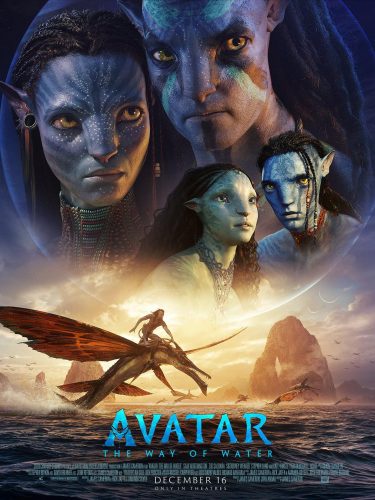
Titre : Avatar, la Voie de l’Eau
Titre original : Avatar, the Way of Water
Réalisé par : James Cameron
Avec : Sam Worthington, Zoe Saldana, Sigourney Weaver, Stephen Lang, Kate Winslet…
Année de sortie : 2022
Durée : 192 minutes
Scénario : James Cameron, Josh Friedman
Montage: David Brenner, James Cameron, John Refoua, Stephen E. Rivkin et Ian Silverstein
Image : Russell Carpenter
Musique : Simon Franglen
Nationalité : États-Unis
Genre : Science-Fiction
Synopsis : Se déroulant plus d’une décennie après les événements relatés dans le premier film, AVATAR : LA VOIE DE L’EAU raconte l’histoire des membres de la famille Sully (Jake, Neytiri et leurs enfants), les épreuves auxquelles ils sont confrontés, les chemins qu’ils doivent emprunter pour se protéger les uns les autres, les batailles qu’ils doivent mener pour rester en vie et les tragédies qu’ils endurent...
Laisser un commentaire