
Flash-back. Dans les années 80, un certain David Lynch voulu se lancer dans l’adaptation de « Goddess », une biographie de Marilyn Monroe signée Anthony Summer. Si le projet s’avérait excitant pour le réalisateur qui sortait tout juste de Blue Velvet, il n’aboutit malheureusement pas, laissant le réalisateur se pencher sur le cas Laura Palmer de Twin Peaks qui deviendra, par ricochet, une autre grande figure féminine sacrificielle, faite des pièces rapportées de l’iconique star. Andrew Dominik qui n’a pas manqué de réviser son petit précis du Lynch illustré (entre autres), sans pour autant travailler le rêve et le fantasme au corps, apprécie quant à lui les chemins de traverse, à rebours des modes et voue lui aussi une certaine fascination pour l’actrice. Après le succès relatif de L’Assassinat de Jesse James par le lâche Robert Ford (2007), il se lance dans l’adaptation de Blonde, roman particulièrement fictionnel de Joyce Carol Oates. Cette approche des événements, parfois fantaisiste, éloigne de fait le film de son socle biopic pour le transformer en démonstration virevoltante de l’enfer hollywoodien prêt à engloutir les bonnes âmes dans les abysses de la gloriole.
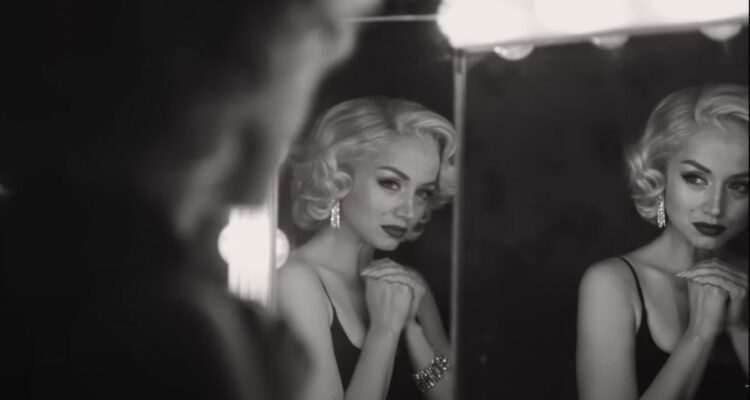
Dense, le projet prendra une dizaine d’années à se concrétiser. Au centre du jeu, Naomi Watts, puis Jessica Chastain sont pressenties mais c’est finalement Ana de Armas, nouvelle coqueluche du tout Hollywood depuis ses prestations dans Blade Runner 2049 et Mourir Peut Attendre, qui emporte la partie. Sa performance éclatante et sans fard donne assez de chair au film pour nous harponner aux deux heures quarante-cinq d’une lente agonie mise en image avec un jusqu’au boutisme esthétisant un poil maniéré qui alterne noir et blanc et couleur sans réelle logique narrative mais également les formats 1.66, cinémascope et les effets optiques qui tripotent un voyeurisme malaisant. Netflix finance, émoustillé par les multiples réappropriations mettant en scène photographies cultes ou extraits exfiltrés de films incontournables (Les Hommes Préfèrent les Blondes, Certains L’aiment Chaud) comme un démontage méticuleux d’un beau livre d’images que le réalisateur essaye de salir à travers l’extraordinaire travail du chef opérateur Chayse Irvin le tout ponctué par la musique de Nick Cave et Warren Ellis. Peu de glamour ici tant la couche de psychotique est épaisse. Si on sait que la vie de Norma Jean Baker fut très éloignée du conte de fée, Blonde étale son épiphanie à la truelle pour en rajouter encore et encore sur la déréliction de la star. Rien de nouveau. L’autre côté du miroir hollywoodien est aussi le sien. Nous y voilà. Et la jeune femme se retrouve logiquement face à sa propre image, observant Marilyn comme un masque mortuaire, une pure création, à la fois sex symbol inaudible d’un public masculin aux visages défigurés par le désir, et monstre indomptable qui la dévore littéralement de l’intérieur. Une scène pivot où la star se fait maquiller face à son reflet laisse poindre cette transformation de Jeckyll en Hyde, de la Norma Jean qui n’aspire qu’à une simple vie de famille à Marilyn Monroe, fantasme incarné par sa propre désincarnation. Cette démonstration un peu grossière d’un corps possédé est symptomatique du procédé narratif et visuel en action. Une forme de schizophrénie qui culminera dans la scène avec JFK et cette fellation imposée à une Marilyn brisée, droguée, chancelante, écrasée par une voix-off qui surligne toujours plus. Toujours trop.
Andrew Dominik pense son film comme un mélange de Raging Bull et Citizen Kane mais à l’instar du Mank de David Fincher (2020) qui déconstruisait également un mythe du cinéma, quitte à travestir les faits, le script manipule la réalité historique avec des grosses pattes pour mieux enfoncer à coups de masse les salmigondis freudiens d’une très longue descente aux enfers. Dialogues avec fœtus en prime. La litanie des souffrances imposées coche ainsi toutes les cases : de la tentative d’homicide (inventée) d’une mère aliénée à la question de l’hérédité d’un fatum programmatique, de l’absence du père fantasmé par une vieille photo au sobriquet de ses amants qu’elle appelle compulsivement « Daddy« . La sur-explication ne joue que trop rarement sur l’inconscient du spectateur et appuie toujours où ça fait mal pour mieux justifier son propos. Naïve, ingénue, violée, battue, trahie, méprisée, incomprise, Marilyn suit dès lors une trajectoire rectiligne et lui donne le rôle figé de victime passive d’un système mortifère, d’un patriarcat rance et gangrené, de relations désespérément travesties qui abandonnent la star à l’impossibilité d’une quelconque normalité quand la folie médicamentée est déjà consommée.
Inexorable. Norma Jean est prisonnière de Marilyn. Enfermée, étouffée par celle-ci, jusqu’à la fin. Entouré par l’horreur d’un système où les affidés se repaissent en exerçant sur elle un pouvoir glaçant de servitude sexuelle, le film stylise à outrance, tente beaucoup, rate souvent à nous investir pleinement dans sa danse macabre. Le résultat est un portrait de femme sous influence servi dans un emballage halluciné qui ripoline salement. Très loin de l’exercice de style plan-plan façon Jackie de Pablo Lorrain (2016) pour ne citer que lui. Et dans le déboulonnage de cette usine à rêves devenus cauchemars, le film ajoute sa lourde pierre. Reste un objet filmique graphiquement splendide, interprété par une Ana de Armas fascinante de candeur expiatoire. Mais à force de vouloir à tout prix faire de Marilyn Monroe la figure post-moderne de la femme exploitée, rabaissée et avilie, Blonde frôle la caricature victimaire tout autant que la réification du mythe.
ENGLISH VERSION
Flash-back. In the Eighties, a certain David Lynch wanted to launch out in the adaptation of » Goddess « , a biography of Marilyn Monroe signed Anthony Summer. If the project was exciting for the director who just came out of Blue Velvet, it unfortunately did not succeed, leaving the director to focus on the case of Laura Palmer of Twin Peaks who will become, by ricochet, another great female sacrificial figure, made of the patches of the iconic star. Andrew Dominik, who did not fail to revise his small precision of the illustrated Lynch (among others), without for all that working the dream and the fantasy to the body, appreciates as for him the crossroads, against the modes and dedicates him also a certain fascination for the actress. After the relative success of The Assassination of Jesse James by the Coward Robert Ford (2007), he embarked on the adaptation of Blonde, a particularly fictional novel by Joyce Carol Oates. This approach to events, sometimes fanciful, takes the film away from its biopic base and transforms it into a twirling demonstration of Hollywood hell ready to swallow up good souls in the abyss of glamour. Dense, the project will take about ten years to materialize. At the center of the game, Naomi Watts, then Jessica Chastain are approached but it is finally Ana de Armas, new darling of Hollywood since her performances in Blade Runner 2049 and James Bond, who wins the game. Her brilliant and unvarnished performance gives enough flesh to the film to harpoon us in two hours and forty-five minutes of a slow agony put in image with an aestheticism a little maniocated which alternates black and white and color without real narrative logic but also the formats 1.66, cinemascope and optical effects to the point of fiddling. Netflix finances, moved by the multiple reappropriations featuring cult photographs or excerpts from must-see films (Gentlemen Prefer Blondes, Some Like It Hot) as a meticulous dismantling of a beautiful picture book that the director tries to dirty through the extraordinary work of the cinematographer Chayse Irvin, all punctuated by the music of Nick Cave and Warren Ellis. There is little glamour here as the layer of psychotic is so thick. If we know that Norma Jean Baker’s life was far from a fairy tale, Blonde spreads her epiphany with a trowel to add more and more on the star’s dereliction.
Nothing new. The other side of the Hollywood mirror is also hers. Here we are. And the young woman logically finds herself facing her own image, observing Marilyn as a death mask, a pure creation, at the same time an inaudible sex symbol of a male public with faces disfigured by desire, and an untamable monster that literally devours her from the inside. A pivotal scene where the star is made up in front of her reflection lets us see this transformation from Jeckyll to Hyde, from Norma Jean who only aspires to a simple family life to Marilyn Monroe, a fantasy embodied by her own disincarnation. This somewhat crude demonstration of a possessed body is symptomatic of the narrative and visual process in action. A form of schizophrenia which will culminate in the scene with JFK and this BJ imposed to a broken, drugged, staggering Marilyn, crushed by a uncomfortable voice-over. Always too much. Andrew Dominik thinks of his film as a mixture of Raging Bull and Citizen Kane, but like David Fincher’s Mank (2020), which also deconstructed a myth of cinema, even if it meant disguising the facts, the script manipulates historical reality with big paws to better hammer in the Freudian mumbo-jumbo of a very long descent into hell. The litany of imposed sufferings ticks all the boxes: from the (invented) homicide attempt of an alienated mother to the question of the heredity of a programmatic fatum, from the absence of the father fantasized by an old photo to the nickname of her lovers that she compulsively calls « Daddy ». The over-explanation only rarely plays on the unconscious of the spectator and always presses where it hurts to better justify its purpose. Naive, ingenuous, raped, beaten, betrayed, despised, misunderstood, Marilyn follows a straight trajectory and gives her the fixed role of passive victim of a mortifying system, of a rancid and gangrenous patriarchy, of desperately transvestite relationships that abandon the star to the impossibility of any normality when the medicated madness is already consumed.
Inexorable. Norma Jean is Marilyn’s prisoner. Locked up, suffocated by her, until the end. Surrounded by the horror of a system where the affidavits feed on her by exerting a chilling power of sexual servitude, the film over-stylizes, tries a lot, often fails to invest us fully in its macabre dance. The result is a portrait of a woman under the influence served in a hallucinatory package that ripples badly. Very far from the plan-plan style exercise like Jackie of Pablo Lorrain (2016) to name but one. And in the debunking of this factory of dreams turned nightmares, Blonde adds its heavy stone. What remains is a graphically splendid filmic object, interpreted by a fascinating Ana de Armas of expiatory candor. But by dint of wanting at all costs to make of Marilyn Monroe the post-modern figure of the exploited, belittled and degraded woman, Blonde borders on the victim caricature as much as the reification of the myth.
Titre : The Northman
Réalisé par : Andrew Dominik
Avec : Ana de Armas, Adrien Brody, Bobby Cannavale, Xavier Samuel, Julianne Nicholson…
Année de sortie : 2022
Durée : 166 minutes
Scénario : Andrew Dominik d’après le roman de Joyce Carol Oates
Montage: Adam Robinson
Image : Chayse Irvin
Musique : Nick Cave, Warren Ellis
Nationalité : États-Unis
Genre : Drame
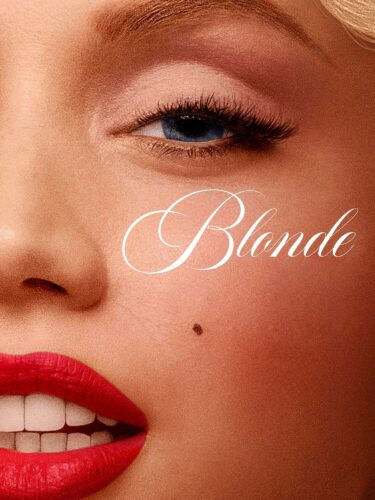
Synopsis : Adapté du best-seller de Joyce Carol Oates, BLONDE est une relecture audacieuse de la trajectoire de Marilyn Monroe, l’une des icônes hollywoodiennes les plus atemporelles. De son enfance tumultueuse à son ascension fulgurante et à ses histoires d’amour complexes – de Norma Jeane à Marilyn –, BLONDE brouille la frontière entre réalité et fiction pour explorer l’écart de plus en plus important entre sa personnalité publique et la personne qu’elle était dans l’intimité....
Laisser un commentaire