
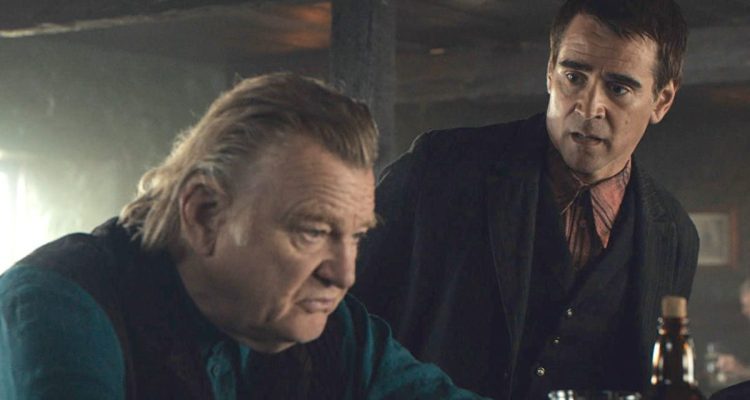
Que se passerait-t-il si un ami de longue date ne souhaitait plus vous parler sans autre raison que la lassitude et le temps qui passe ? En partant sur ce postulat très théâtral et malgré le décor insulaire d’un îlot irlandais en pleine révolution des années 20, Les Banshees d’Inisherin démarre à la manière d’une pièce de Samuel Beckett. L’absurde en ligne de mire. Mais pas que. Paumés dans ce petit monde partagé entre le village et le pub, Padraic (Colin Farrell) et Colm (Brendan Gleeson) ne s’entendent plus, ou plutôt le dernier en question, violoniste d’occasion, s’est subitement découvert une passion obsessionnelle pour la l’instrument et la composition d’un hymne. Résultat, il ne veut plus entendre causer dans le vide son ancien comparse de beuverie qu’il juge « limité » alors que la vie est bien trop courte pour se cantonner à de telles futilités. Mais n’est-ce pas tout le propos de ce film que de regarder le monde s’ébrouer ? Car sur la côte irlandaise, juste en face, les canons tintamarrent comme autant de rappels à l’ordre d’un monde en plein chaos. Mais c’est bien l’univers de Paidric qui traverse la tempête. Invariablement « bon » et sans « méchanceté », il ne comprend pas l’attitude de son ami et il va donc s’acharner, malgré les mises en garde de sa sœur Siobhan (Kerry Condon), à reconquérir cette amitié perdue. Et cogner le jusqu’au boutisme en plein cœur. Avec ce quatrième film, Martin McDonagh (Bons Baisers de Bruge, Three Billboards) confirme qu’il est un auteur toujours aussi habile dans l’écriture décalée, avec une narration impeccable, implacable, que son expérience du théâtre alimente sans jamais phagocyter une réalisation au plus près de ses acteurs. Filmé à hauteur d’Homme (avec majuscule), ce dont il est question, le film n’hésite pas à embrasser ses thèmes sur un fond politique et humaniste assumé. La tourbe, la lumière vacillante, ces ambiances festives autour d’une pinte, enveloppe ces personnages qui aspirent aux choses les plus simples : Colm ne veut rien d’autre que jouer du violon, composer et regarder l’océan, seul avec son chien, Paidric se contente de vivre tranquillement avec ses vaches, son ânesse et une sœur passionnée de littérature qui aspire, elle, à s’extirper de ce monde en dehors du monde pour aller vivre à la grande ville parmi les livres. Au milieu des histoires. La fable est grinçante, dévorée par une forme de blues permanent où plane la mort de l’âme sans jamais se noyer dans le mortifère. Avec un sens du décalage d’où surgissent quelques fulgurances drôlatiques, Les Banshees D’Inisherin joue le spleen et la mélancolie joyeuse typiquement irlandaise, dans une allégorie qui pourra être ressentie comme une tristesse absolue lorsque l’ami un peu dérangé Dominic, interprété par Barry Keoghan, est simplement éconduit par Siobhan et qui s’achève par un laconique « There Goes That Dream » à briser les pierres. Dans ce traité grotesque de la solitude, cette bizarrerie macabre et cruel mais recouvert d’un humour noir qui explore la nature humaine avec acuité, Martin McDonagh parvient à poser sa caméra sans condescendance pour les petites gens perdues dans leurs angoisses, ni misérabilisme, ni jugement sur leurs aspirations. Et si le film tire un peu sur les cordes sensibles, il provoque assez de sentiments contradictoires pour ne jamais laisser indifférent. Sans prétendre au conte métaphysique, Les Banshees d’Inisherin est une parabole assez fascinante de notre propre regard sur le sens de la vie. Une ballade irlandaise en quelque sorte.
ENGLISH VERSION
What would happen if a long-time friend no longer wished to speak to you for no other reason than weariness and the passage of time? Starting with this very theatrical premise and despite the insular setting of an Irish island in the midst of the 1920s revolution, The Banshees of Inisherin starts out like a Samuel Beckett play. The absurd in the line of fire. But not only. Padraic (Colin Farrell) and Colm (Brendan Gleeson) are lost in this small world divided between the village and the pub. The latter, a second-hand violinist, has suddenly discovered an obsessive passion for the instrument and the composition of a hymn. As a result, he no longer wants to hear his former drinking buddy talking in a vacuum, whom he considers « limited », while life is far too short to be confined to such trivialities. But isn’t the whole point of this film to watch the world go to pieces? Because on the Irish coast, just across the street, the cannons ring out like so many reminders of a world in chaos. But it is Paidric’s world that is going through the storm. Invariably « good » and without « malice », he does not understand his friend’s attitude and he will therefore persist, despite the warnings of his sister Siobhan (Kerry Condon), to win back this lost friendship. And to hit the heart of the matter. With this fourth film, Martin McDonagh (In Bruge, Three Billboards) confirms that he is still a skilled author of offbeat writing, with an impeccable, relentless narrative that his experience in theater feeds without ever overpowering a direction that is as close as possible to its actors. Filmed at the height of Man (with a capital letter), which is what it is about, the film does not hesitate to embrace its themes on an assumed political and humanistic background. The peat, the flickering light, the festive atmosphere around a pint, envelops these characters who aspire to the simplest things: Colm wants nothing more than to play the violin, to compose and to look at the ocean, alone with his dog, Paidric is content to live quietly with his cows, his donkey and a sister who is passionate about literature and who aspires to escape from this world outside the world to go and live in the big city among the books In the middle of stories. The fable is grating, devoured by a form of permanent blues where the death of the soul hovers without ever drowning in the mortiferous. With a sense of discrepancy from which emerge some funny flashes, The Banshees of Inisherin plays with the spleen and the typically Irish joyful melancholy, in an allegory that could be felt as an absolute sadness when the slightly deranged friend Dominic, played by Barry Keoghan, is simply spurned by Siobhan and that ends with a laconic « There Goes That Dream » to break the stones. In this grotesque treatise of loneliness, this macabre and cruel oddity but covered with a black humor that explores human nature with acuity, Martin McDonagh manages to put his camera without condescension for the little people lost in their anguish, nor miserabilism, nor judgment on their aspirations. And if the film pulls on the heartstrings a little, it provokes enough contradictory feelings to never leave one indifferent. Without pretending to be a metaphysical tale, The Banshees of Inisherin is a rather fascinating parable of our own view on the meaning of life. An Irish ballad in a way.
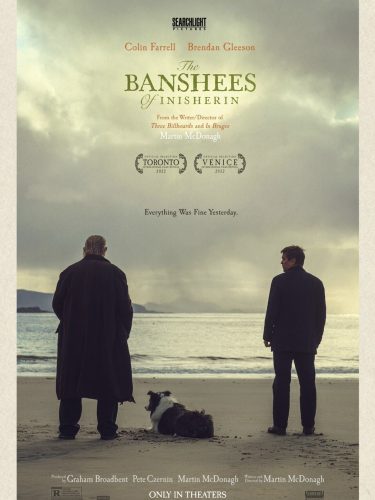
Titre : Les Banshees d’Inisherin
Titre original : The Banshees of Inisherin
Réalisé par : Martin McDonagh
Avec : Colin Farrell, Brendan Gleeson, Barry Keoghan, Kerry Condon…
Année de sortie : 2022
Durée : 109 minutes
Scénario : Martin McDonagh
Montage: Mikkel E.G. Nielsen
Image : Ben Davis
Musique : Carter Burwell
Nationalité : États-Unis / Irlande
Genre : Drame
Synopsis : Sur Inisherin – une île isolée au large de la côte ouest de l’Irlande – deux compères de toujours, Padraic et Colm, se retrouvent dans une impasse lorsque Colm décide du jour au lendemain de mettre fin à leur amitié. Abasourdi, Padraic n’accepte pas la situation et tente par tous les moyens de recoller les morceaux, avec le soutien de sa sœur Siobhan et de Dominic, un jeune insulaire un peu dérangé. Mais les efforts répétés de Padraic ne font que renforcer la détermination de son ancien ami et lorsque Colm finit par poser un ultimatum désespéré, les événements s’enveniment et vont avoir de terribles conséquences...
Laisser un commentaire